GHS-XRC(M) Hazard Declassification (Inversion)
To: Favored Client
From: Don Ewert, Operations Manager
Date: 03/18/2022
Re: Whole Grain Sand – GHS, HazCom 2012 & Prop-65 Hazard Declassification (Inversion)
GHS-XRC(M) Hazard Declassification (Inversion)
CHARACTERIZATION STRATEGIES
Following our conversation today, I’m pleased to offer the attached Analytical Request detailing those processes we’ll utilize to characterize your “Whole Grain Sand” product. I think you’ll find this information to be self explanatory, but some discussion may be of value so I’m including it herein.

GHS-XRC(M) Hazard Declassification (Inversion)
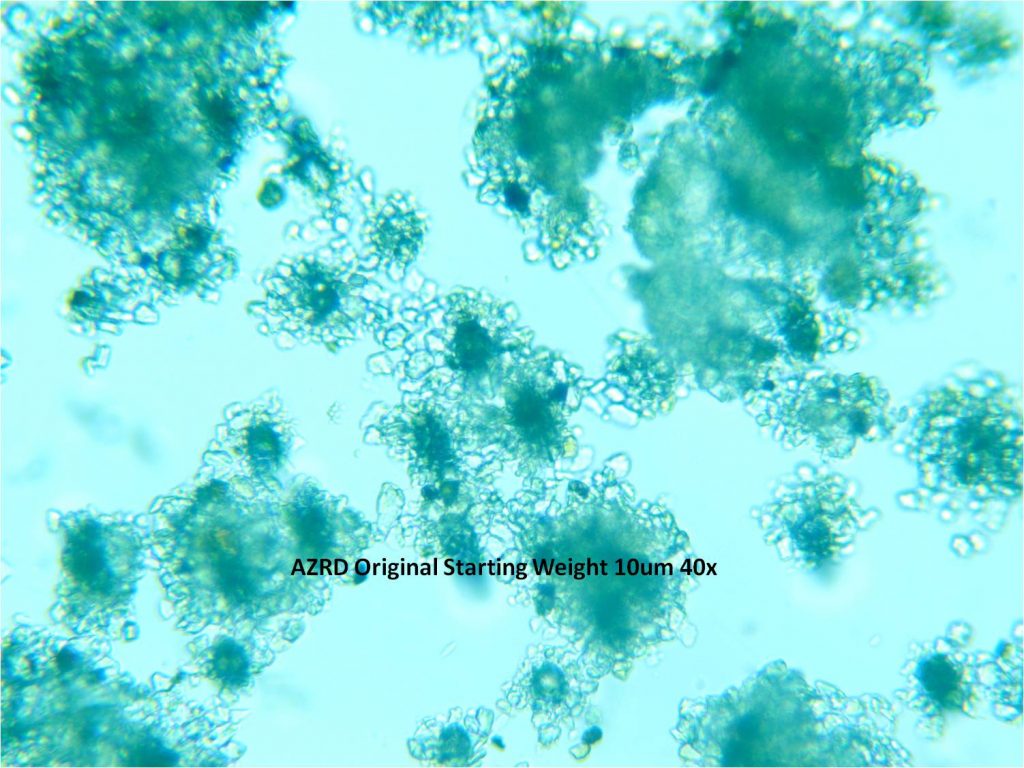
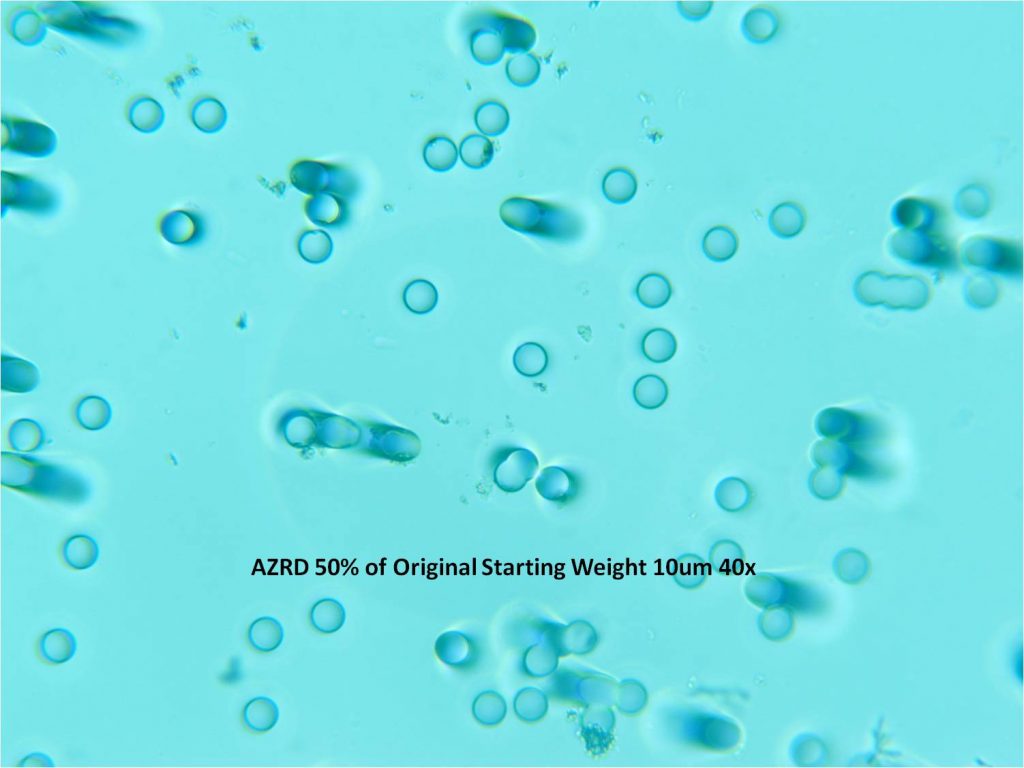
For our determination of the Respirable Crystalline Silica (RCS) content, we will utilize our proprietary Vacuum Filtered Fractionation (VFF) technique, including a Starting Weight Study to maximize filtration efficiency, to quantify the respirable fraction. To better describe this, VFF is performed by first wet-sieving the material to isolate the >38µm fraction. Once this particulate is removed, we process the liquid filtrate through a 10µm or 5µm filter (depending on desired regulatory clearance) using an Isopore Polycarbonate Membrane Filter. Since you folks are primarily concerned with Prop-65, we will be proceeding with 10µm fractionation which is more conservative, but addresses both GHS and Prop-65 compliance. As you’ll see in the images below, these filter membranes consist of precisely sized pores which must remain open and available to the <10µm particulate as it is filters through the membrane. Should this particulate agglomerate or physicochemically block pores (sugar effect) filtration is prohibited, resulting in artificially low outcomes for the true RCS content. Obviously, this represents a favorable regulatory outcome, but isn’t defensible. To better describe the process, I offer the two images below of an ISO Standard (Arizona Road Dust) we use for validation showing the 10µm filter pores blocked and open after filtration. When the pores remain available, filtration outcomes are fully reproducible and validated. Once they fill, however, and are unable to process particulate, the final outcomes become invalid and irreproducible.
Basically what all this means is that we will process your material through 3-5 Starting Weights using an abbreviated VFF process and examine final filter loading using Digital Microscopy to determine the ideal Starting Weight for fractionation.
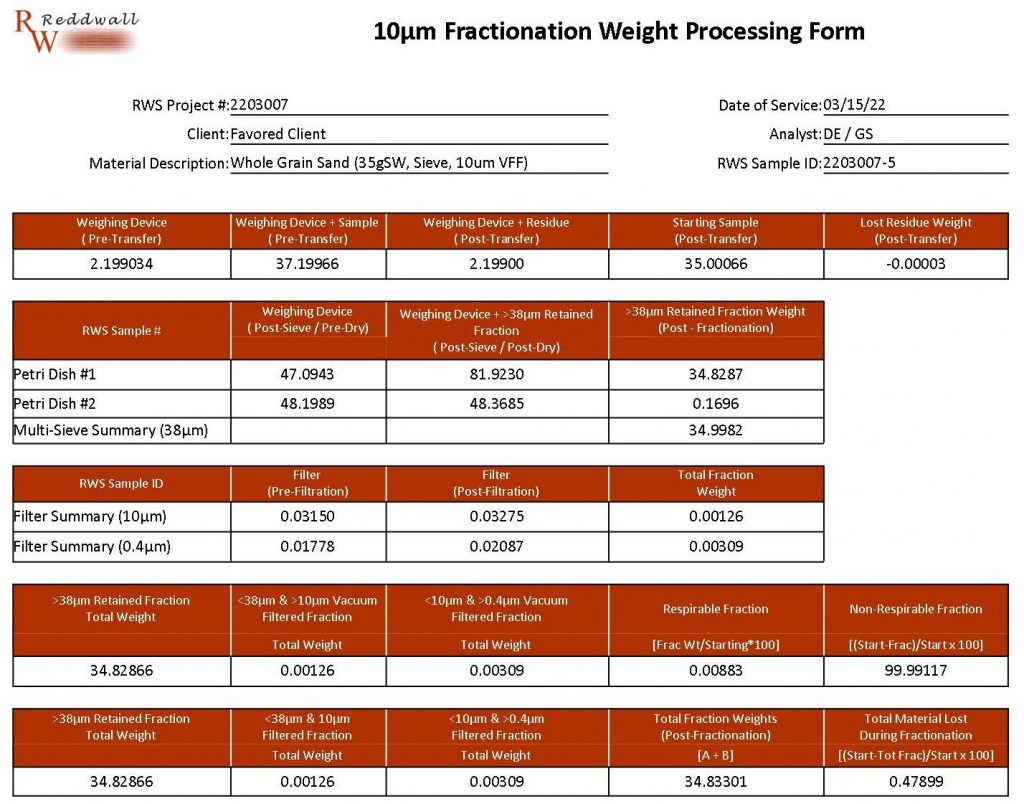
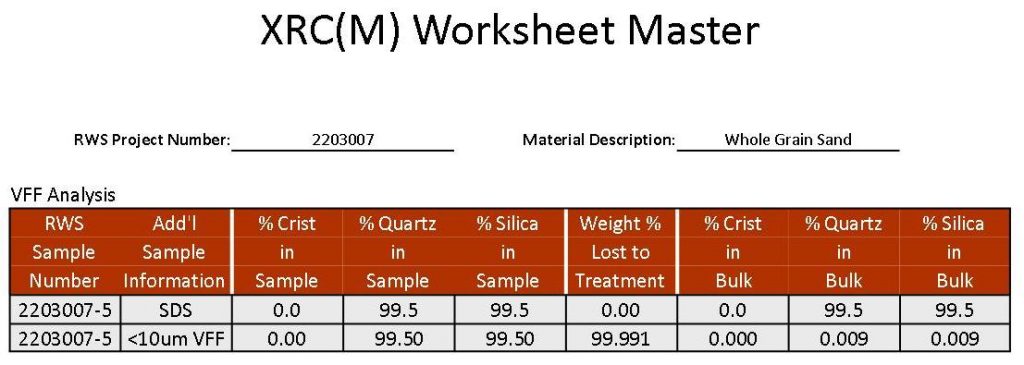
Once we have the Starting Weight, we’ll initiate VFF work and process a carefully prepared sample through our full VFF analysis regimen. This will result in an accurate value for the isolated respirable fraction weight percent between 10µm and 0.4µm. One other important consideration in this process is determining the mass balance between Starting Weight and sum of final residue weights for each of three fractions. More specifically, upon completion of the VFF process, we sum the three residue weights (>38µm, >10µm and >0.4µm) and compare this total to the Starting Weight. The outcome of this analysis provides us with an assessment of material losses accompanying this process. For the vast majority of materials, losses are limited to <1%, but occasionally they increase/decrease significantly due to particulate binding, surface affinity and agglomeration or as a result of lost salt content. In both cases, the particulate losses/gains are considered to be unavailable biologically and non-respirable. Thus, they’re accounted for, wherever the loss basis can be substantiated. If we do see a significant change in mass balance, we’ll need to account for this in final reporting.
Upon receiving the analysis outcome from VFF characterization, we’ll further determine whether the weight % associated with the respirable fraction is in excess of our GHS/Prop-65 non-detection threshold of <0.01 wt% or if it is in excess of this value. Assuming the outcome demonstrates a non-detectable level of respirable particulate; services will terminate with issuance of final reporting and archiving of project materials and documentation. Should the result be at or in excess of 0.01 wt%, however, we will prepare the filter residue for further analysis of the Crystalline Silica content by XRD-Air. This will then serve as our determining factor in recommending GHS/Prop-65 clearance.
Should it be necessary to process the 0.4µm filter, containing respirable residues, into XRD-Air for analysis, we have the advantage of providing XRD with the respirable residue weight for further derivation purposes. Thus, any disruption in particulate during interlaboratory filter transfer is irrelevant and outcomes won’t change, regardless of sample handling disturbances. Additionally, since the XRD-Air method employs Plasma Ashing, no artificial chemicals are introduced and results are truly reflective of the Crystalline Silica concentration in those residues undergoing analysis. Finally, depending on the desired accuracy level, XRD-Air analysis routinely achieves an LOD for Crystalline Silica of 5µg/filter, but can be run to an LOD of 2.5µg/filter.
Finally, you requested that this work be conducted under GLP standards. Having developed our entire laboratory operation in accordance with these principles, we’re pleased to offer this additional service level including analysis, project-specific calibration, documentation and digital recording of all laboratory activities. We will also download the relevant surveillance data to file and retain this information, together with our work product, for an extended period of time. Thus, making the work fully auditable by your group for many years to come.
In summary, here are our recommendations for characterization and Hazard Declassification of the “Whole Grain Sand” material:
– VFF Starting Weight Study w/Digital Microscopic Analysis of Filters
– VFF Sample Characterization and Isolation of Respirable Fraction (10µm)
– XRD-Air Quantitation of Crystalline Silica concentration in Respirable Fraction (if needed)
– GHS-Level Toxicological Reporting of Outcomes and Clearance Achievements
– GLP Level Analysis, Calibration, Documentation, Reporting & Archiving
Hopefully, this information has been helpful. We look forward to working with your group and welcome any additional questions or inquiry you may have.
GHS-XRC(M) Hazard Declassification (Inversion)
STARTING WEIGHT STUDY
As mentioned earlier today, we’ve completed both, an evaluation of physical properties and a Starting Weight Study. With everything proceeding as anticipated, we’ll begin 10µm Vacuum Filtered Fractionation (VFF) early next week. Assuming it goes as planned, we anticipate completing work within a day or two thereafter.
In support of services provided thus far, attached is our VFF Starting Weight workbook. Within this, you will find a number of data sheets detailing this analytical process. One such tab reports our Material Properties Assessment which involves evaluating particle types and the size distribution of suspended particulate after vortex mixing. While this step doesn’t include fractionation, we do use a small section of 10µm polycarbonate filter for particulate and agglomerate sizing. Another important aspect of this work is determining the amount of preexisting ultrafine particulate agglomeration, with this data helpful in assessing the proper Starting Weight range. For the “Whole Grain Sand” product, we saw freely available particulate in the size range <10µm and only limited agglomeration, allowing us to set up a Starting Weight range of 10g-100g.
GHS-XRC(M) Hazard Declassification (Inversion)
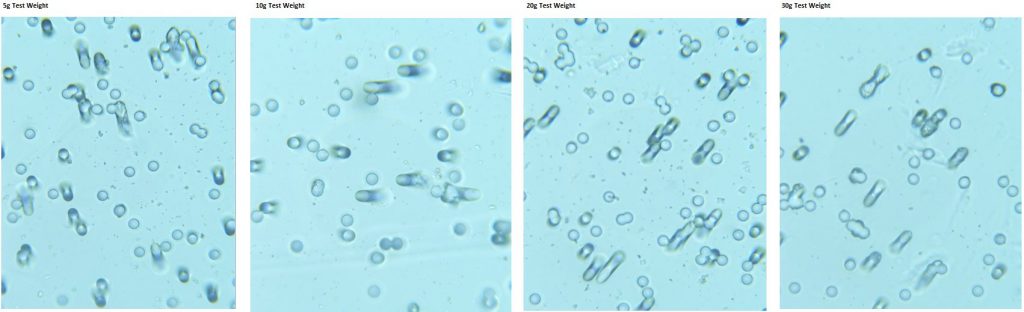
Once we determined that the product contained fine particulate with no obvious agglomeration, we proceeded with a Starting Weight Study to assess the loading level capable of yielding ideal filtration outcomes. More specifically, this goal with this work is to determine the highest Starting Weight possible to maximize LOD while also yielding efficient filtration and a majority of the 10µm pores open and available. This becomes important for reproducibility by enhancing the ability to detect and accurately quantify <10µm particulate residues with 3 decimal precision.
As a key part of this Starting Weight Study, we digitally examined 10µm filter performance at each selected Starting Weight. Once collected, these images were statistically analyzed to quantify pore inhibition randomly collected microscopic 40x field images. This study found that at a 10g Starting Weight, 10µm pore inhibition was limited (85% clear) while at the Starting Weight of 50g, more pronounced inhibition occurred, yielding a reduced clearance rate of 56%. Finally, at 100g, pore inhibition was extensive with a prohibitive clearance rate of only 10%. In light of this information, we’ve chosen a VFF Starting Weight of 35g for quantitation of the <10µm respirable fraction. Starting with this amount, we should realize an effective clearance rate of 65%-70% and highly accurate/reproducible results for the <10µm respirable fraction (wt %). Herein are the data and images we utilized to make these determinations:
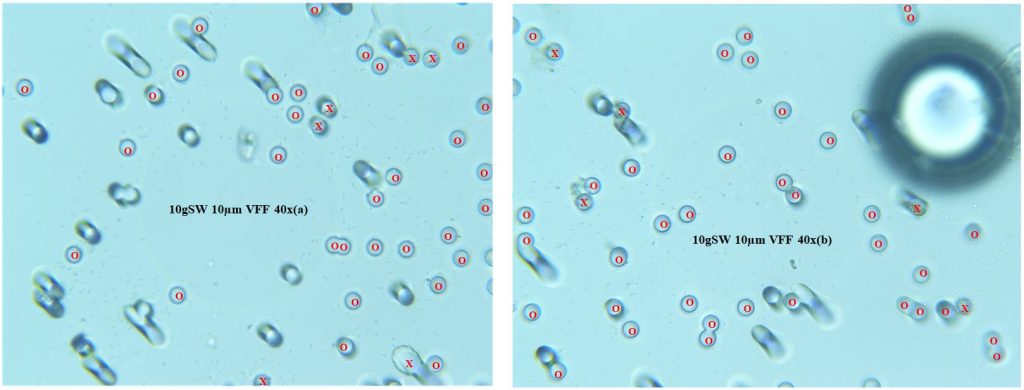
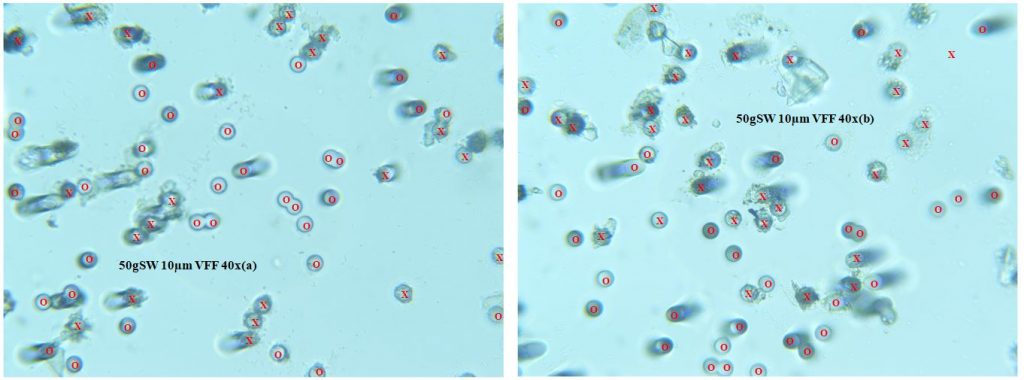
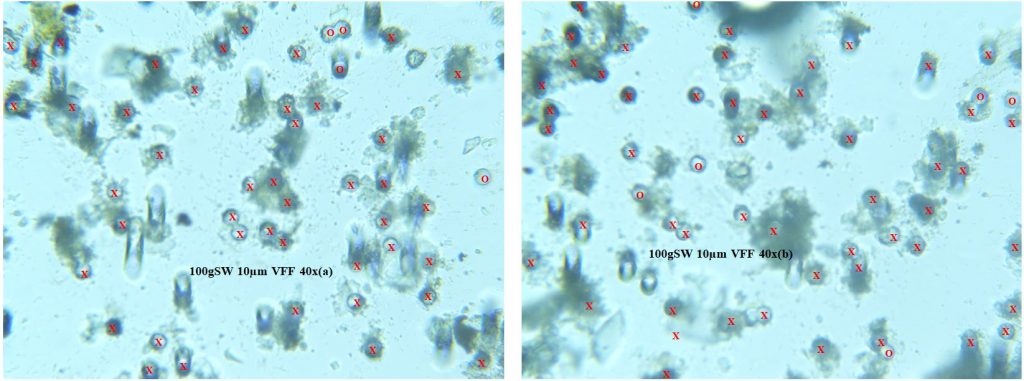
GHS-XRC(M) Hazard Declassification (Inversion)
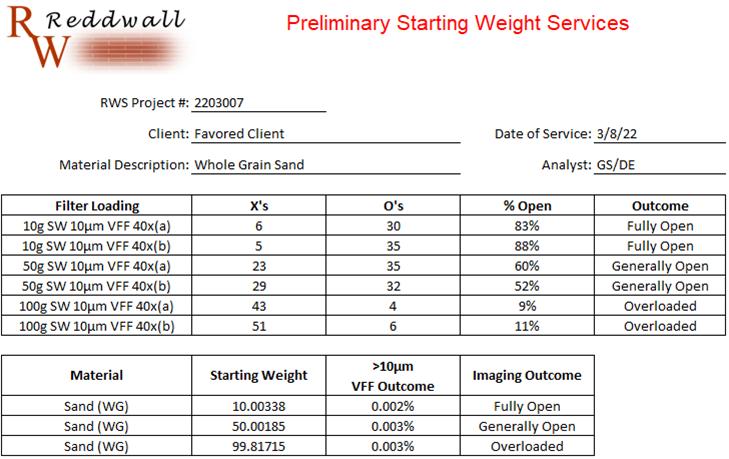
GHS-XRC(M) Hazard Declassification (Inversion)
With appreciation for the opportunity to be of service, we welcome any questions or comments you might have and look forward to successfully completing this work.
GHS-XRC(M) Hazard Declassification (Inversion)
VACUUM FILTERED FRACTIONATION (VFF)
As mentioned earlier today, we’ve completed Vacuum Filtered Fractionation (VFF) of the “Whole Grain Sand” product you submitted for characterization. Based on the outcome of this testing, we recommend that the material does not have a detectable respirable fraction for GHS, HazCom 2012 and Prop-65 regulatory purposes (<0.01 wt %). Thus, the product should not be considered hazardous and instead, inverted to non-hazardous for the ingredient, Respirable Crystalline Silica (RCS). Herein is additional information, detailing our analysis results:
GHS-XRC(M) Hazard Declassification (Inversion)
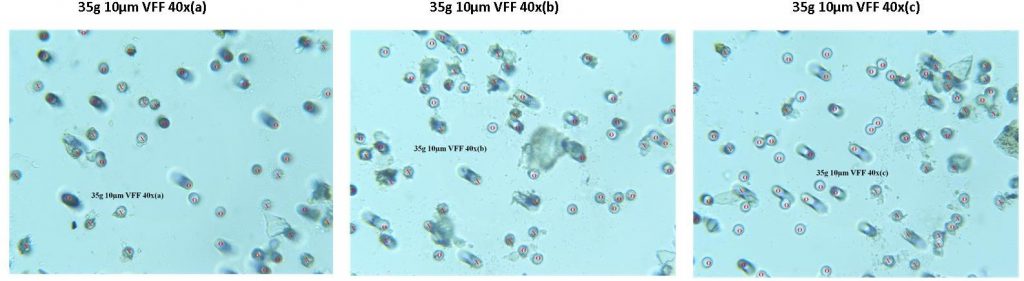
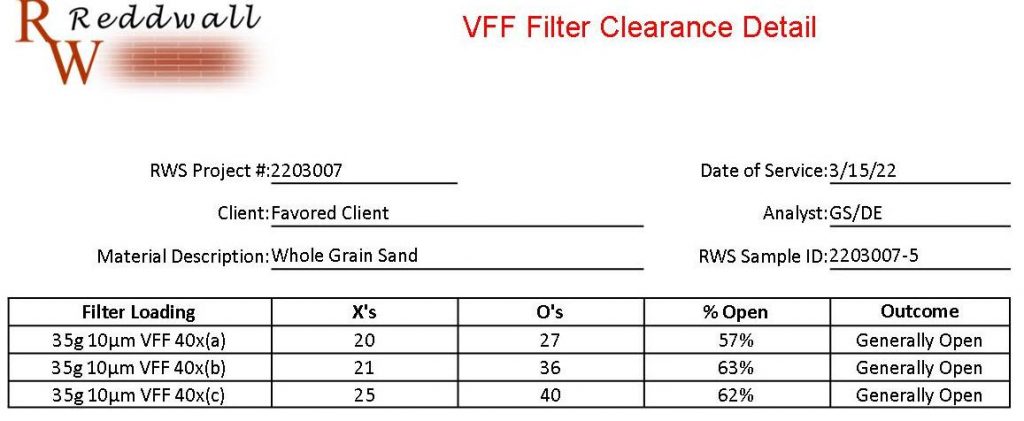
As a part of this VFF process, we also evaluated the final 10µm filter for its ability to allow uninhibited flow of <10µm particulate to the final 0.4µm filter. The results of this testing demonstrated that the majority of pores remained available throughout the fractionation process. Herein are the filter images we utilized to make this determination and a tabular reporting of these results.
GHS-XRC(M) Hazard Declassification (Inversion)
As a part of this VFF process, we also evaluated the final 10µm filter for its ability to allow uninhibited flow of <10µm particulate to the final 0.4µm filter. The results of this testing demonstrated that the majority of pores remained available throughout the fractionation process. Herein are the filter images we utilized to make this determination and a tabular reporting of these results.
GHS-XRC(M) Hazard Declassification (Inversion)
GHS-XRC(M) Hazard Declassification (Inversion)
With the analytical details now available and requested work completed, we will initiate preparation of a GHS-Compliant XRC(M) Report, summarizing our findings, including recommendations for SDS Section 3 Hazard Declassification language, describing our basis for Hazard Inversion of this product.
We look forward to any comments or questions you might have relative to this reporting or any other that we’ve provided.
GHS-XRC(M) Hazard Declassification (Inversion)
HAZARD DECLASSIFICATION (INVERSION)
As discussed earlier today, find attached our GHS-XRC(M) Reporting on Hazard Declassification and Inversion for your “Whole Grain Sand” As-Presented (AP) product to a non-hazardous classification for GHS/HazCom 2012 and Prop-65 regulatory purposes. In keeping our prior reporting, this material fails to demonstrate a detectable <10µm respirable fraction. As a result, we terminated further Crystalline Silica analysis of filter residues and consider the Respirable Crystalline Silica (RCS) content in this product to be non-detectable as well.
As a result of these findings, we also recommend that the applicable Safety Data Sheet undergo declassification for the Crystalline Silica hazard and be rewritten as non-hazardous so that handling activities, including transportation, can be performed without engineering controls or personal protective equipment. Toward this goal, we’ve also included our SDS Section 3 language package, providing you with our recommendation for author changes and attesting to the scientific basis for Hazard Inversion.
Should you see any textual corrections or errors, please advice so they can be promptly corrected. Finally, we sincerely appreciate the opportunity to have been of service and look forward to future contact.
GHS-XRC(M) Hazard Declassification (Inversion)