MEMORANDUM
To: Favored Client
From: Don Ewert, Operations Manager
Date: 02/09/2022
Re: Carbon Black GHS/HazCom 2012 & Prop-65 Reclassification
XRC(M) Case Study – Carbon Black
Thank you for the opportunity to review our reclassification services and to describe in detail how we propose characterizing your Carbon Black product.
While XRD Bulk Analysis and Quantitation for total Crystalline Silica is relatively straightforward and involves sequential analysis steps (if needed), we’ll take the simplest approach first, including Heat Pretreatment of the material followed by standard XRD Analysis. Because of material reductions via pretreatment, we should be able to achieve reliable 2-decimal quantitation without the need for additional characterization. Should this fail to provide the reliability and accuracy we’re looking for, however, we can rerun the sample using longer scan times to reduce background noise and attain better resolution. Either way, we’ll see 2-decimal place reporting in the outcome.
For the determination of Respirable Crystalline Silica (RCS) content, we will utilize our enhanced Vacuum Filter Fractionation (VFF) technique, including a Starting Weight Study to maximize filtration efficiency. To better describe this, VFF is performed by first wet-sieving the material to isolate the >38µm fraction. Once these large particulate are removed, we process the liquid filtrate through a 10µm or 5µm filter (depending on desired regulatory clearance) using Isopore Polycarbonate Membrane Filters. As you will see in the image below, these filter membranes consist of precisely sized pores which must remain open and available to the <38µm particulate as it is processed through the membrane. Should the particulate agglomerate or physicochemically block the pores, filtration is prohibited, resulting in artificially low outcomes for the true RCS content. Obviously, this yields a favorable outcome from a clearance perspective, but isn’t defensible. To better describe this process, I’m providing below two images for an AZ Road Dust Standard we run for our validation regimen that shows the filter pores blocked and open after filtration. When the pores remain available, filtration outcomes are fully reproducible and validated. Once they fill, however, and are unable to process particulate through the filter, final outcomes are invalid and not reproducible.
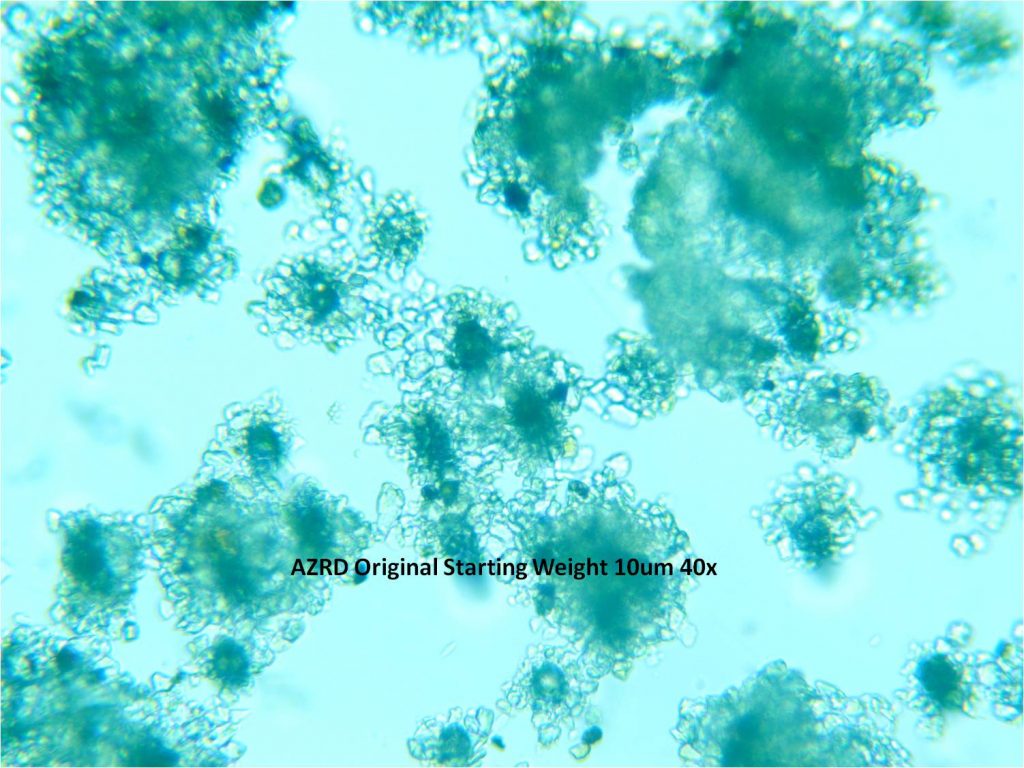
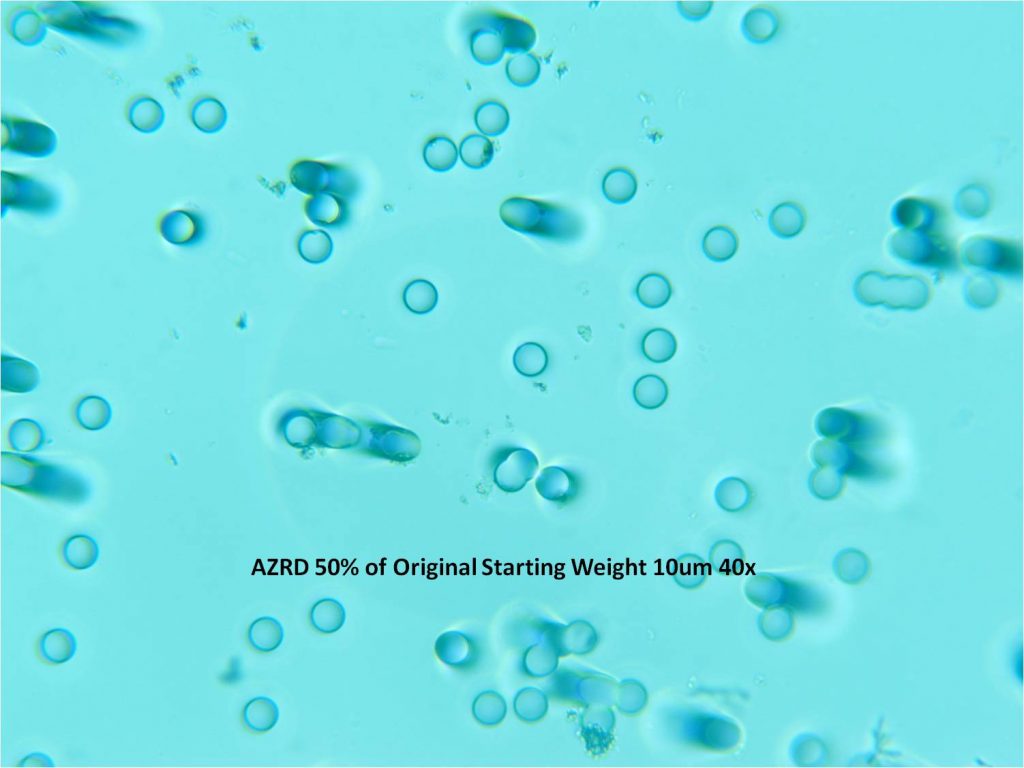
Basically what this means is that we will process your material through 3-4 starting weights using an abbreviated VFF process and examine the final Isopore filters with digital microscopy to determine the ideal starting weight for fractionation. Thereafter we will process a carefully prepared sample through our full VFF analysis regimen and confidently determine the weight percent of isolated respirable fraction between either 10µm and 0.4µm or 5µm and 0.4µm, depending on desired clearance tolerance. There is no difference in pricing between 5µm and 10µm VFF since these processes are identical.
Once we have the ideal starting weight range, we will initiate VFF work. An overview of the significant differences between the techniques we utilize and those which others employ include:
We always derive mass balance information between starting weight and residue weights (3 fractions). More specifically, upon completion of the VFF process, we combine the three residue weights together (>38µm, >10µm and >0.4µm) to determine material losses as a part of the process. For the vast majority of materials, this loss is limited and <1%. Occasionally, we come across products with high surface affinity and experience losses in 10%-20% range. For these materials, the losses are considered to be unavailable biologically and non-respirable. Regardless, no technique besides ours incorporates mass balance into the process. Provided we have reproducibility and validation in our VFF results, we will proceed with the next level of analysis under standard protocol conditions. If not, we will look at alternative paths for subsequent analysis. This is an important consideration and significantly affects outcomes.
- The laboratory is under 24/7 surveillance to assure that all protocols are continuously followed, regardless of staff and that Chain-of-Custody is continuously maintained throughout the process for every material.
- RWS routinely offers isolation of the biologically relevant 5µm fraction at no additional cost. Other methods, capable of capturing the 5µm fraction, are cumbersome, expensive due to extended settling times and unreliable as a result of significant material losses. Our team of toxicologists has validated this method across GHS, WHMIS, REACH and HazCom 2012 regulations and has a long history of attaining legal and regulatory agreement with the outcomes.
- To assure that we’re deriving the best detection level available, we’ve eliminated all lab ware having weights in excess of 20g from the quantitation process. This action allows our analytical balances to consistently report to the 5th decimal place, improving the reliability of quantitative outcomes, lowering material losses and significantly enhancing reproducibility.
- We’ve eliminated metals and plastics from the VFF process as much as feasible. In most laboratories, metal trays and plastic cases are used to collect, store, dry and transfer residues and filters. We no longer use metal or plastic in our drying and material handling processes, shifting to lightweight glass apparatus instead. This eliminates the effects of pan corrosion, physicochemical heating reactions in plastics and unwanted static electricity build-up, all of which destabilize weight outcomes.
- With our newly constructed facility, we were meticulous in creating a highly controlled laboratory environment, stabilizing temperatures, humidity and static to within 1% across all processes thus, minimizing environmentally induced weight variations.
- All analytical weights are obtained in quintuplicate and the data processed through standard statistical analysis to remove outliers before being rolled up into further derivations.
- Our fractionation process utilizes biologically neutral 0.1% Phosphate Buffered Saline (PBS) solution as the liquid filtration medium. Other methods use Deionized Water and/or Anticoagulant solutions as the fractionation medium. Since neither of these are naturally occurring and both generate physicochemical particle affects, we consider their use to be unnatural, leading to non-representative outcomes.
- Where ever possible, we’ve suspended the use of Computer Controlled Scanning Electron Microscopy (CCSEM) as a quantitation tool in determining RCS content. Given the fact that CCSEM is only able to provide information on Si-Rich particulate and isn’t capable of offering crystallinity details, we’ve gone to internationally validated XRD-Air analysis (NIOSH 7500) to determine true crystalline silica content in the respirable fraction. This technique gives us 3-decimal accuracy and an exceptional level of reproducibility.
- We specifically prohibit the use of organic solvents during filter processing and/or sample prep since these chemicals are completely unnatural to the occupational/environmental exposure scenario. It should be noted that during sample prep for CCSEM analysis, most residues are reconstituted to a special CCSEM filter using organic solvents.
While 10µm and 5µm VFF services are priced identically, the difference in pore size can produce dissimilar outcomes, depending on material. For those products made up primarily of fines and ultra fines (PM <2.5) the pore size difference may not have a significant affect. For materials having a high course particulate content (PM >2.5) however, this variation can be significant with the <5µm VFF clearing GHS while the <10µm may not. Unfortunately, this factor also complicates Prop-65 clearance because of the fact that Prop-65 is based on OSHA regulations which only recognize the 10µm size fraction in determining clearance. Fortunately, we can use the 10µm VFF for GHS clearance as well so success across this regimen means success for both GHS/HazCom 2012 and Prop-65. Be aware, however, that Prop-65 necessitates a “non-detect” finding which means that the final RCS outcome must be <0.01 wt% (non-detect) to achieve clearance. Should Prop-65 be your desired threshold, then the 10µm VFF process is necessary. Normally, we recommend achieving GHS/HazCom 2012 clearance first using a 5µm VFF and thereafter, with results in hand, determining whether Prop-65 clearance is a viable option. Obviously, this adds cost, but getting past GHS/HazCom 2012 does have significant international value.
As mentioned above, we normally process the 0.4µm filter containing respirable residues into XRD-Air for analysis. An advantage of this is that we’re able to provide XRD with the total respirable residue weight for derivation purposes. Thus, any disruption in particulate during interlaboratory filter transfer is irrelevant and won’t change outcomes, regardless of handling error. Additionally, since the XRD-Air method employs Plasma Ashing, no artificial chemicals are introduced and results are truly reflective of the residues undergoing analysis. This technique offers two quantitation levels; the first is 5.0µg/filter while the second is at 50% of this value (2.5µg/filter). Similar to what I’ve discussed previously, the difference between these two quantitation thresholds is analysis time with longer run times resulting in better quantitation. Since we rarely have a need for the lower LOD, we simply run samples at the upper LOD, saving money.
Hopefully, this information has been helpful to your considerations. We certainly look forward to again working with your group and welcome any additional questions or inquiry you may have. Regards,