Reddwall Solutions’ Dustiness Testing System
Create White Space
Determining the exposure potential of industrial materials is an important part of product characterization and basic to regulatory compliance. Under GHS, CLP and Prop-65 rules, dustiness information is often utilized to assure that potential handling and exposure risks have been evaluated so they can be controlled or minimized where needed.
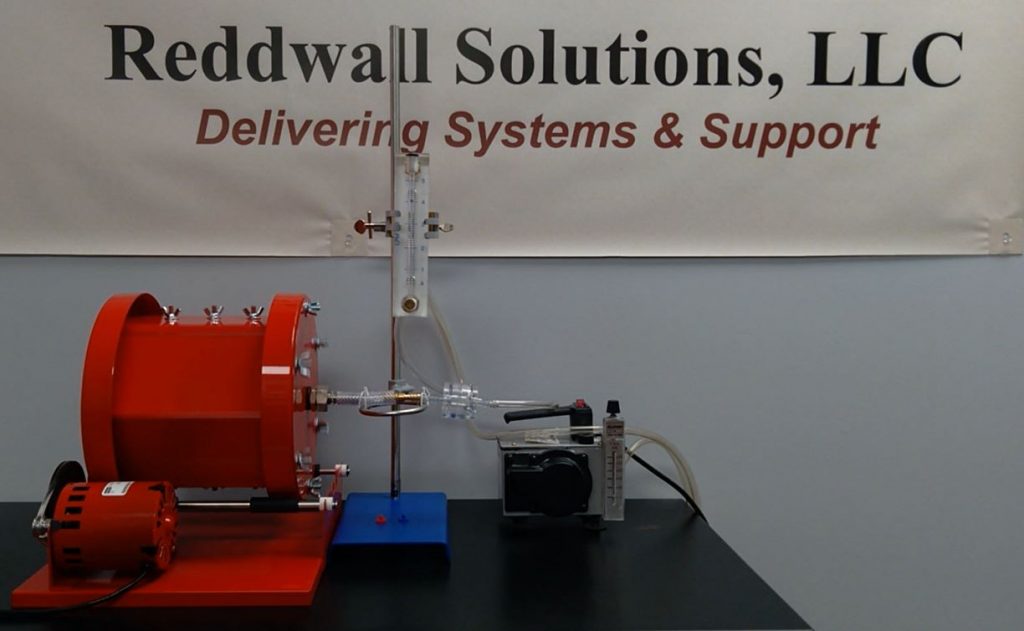
The dustiness testing system we’ve developed is capable of processing a wide range of industrial materials and provides highly accurate and reproducible data across a range of starting weights. Dusts are generated and captured via the Rotating Drum design (CEN-EN 15051-2) with industrial material modifications in accordance with the Heubach rotating drum approach (DIN 55992).
Reddwall Solutions’ Dustiness Testing System determines dusting potentials across a range of materials and product classes. As constructed, it’s capable of testing of either inhalable (total) or respirable (<10µm) dusts and serves as an effective means of conducting comparative analysis of products or to monitor formulation changes. Finally, because this system is fully contained, it’s adaptable to either solid or liquid formulations.
Reddwall Solutions is a leading provider of health and safety solutions to industry, commerce and professional bodies. We have a wealth of expertise and experience, enabling us to provide practical solutions to a broad spectrum of workplace needs.
Dustiness Testing
Dustiness is defined as the propensity of materials to produce a particulate aerosol during handling. The release of unwanted dusts can affect:
· Worker exposure levels;
· Ventilation and filtration system demands;
· Material losses and cross-contamination.
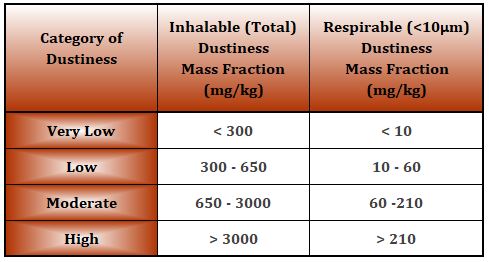
With a design mimicking the European Standard EN 15051:2006 “Workplace atmospheres – Measurement of the dustiness of bulk materials – Requirements and reference test methods” and incorporating “Heubach” modifications both the system and process, results are reported in mass fraction values for comparison with EN15051 classification thresholds involving inhalable (total) and respirable (<10µm) dustiness.
Dustiness and Risk Assessment
Dustiness and Risk Assessment
Dustiness evaluations are used within the broad spectrum of material characterization methods to inform risk assessment with the amount of dustiness generally dependant on material and process-specific parameters including:
· Particle size distribution;
· Surface potential;
· Moisture content.
In addition to conducting dustiness assessments, our proprietary Vacuum Filtered Fractionation (VFF) technique isolates and quantifies the 10µm and 5µm respirable fractions. Upon collection, these residues are analyzed for agents of concern such as Crystalline Silica and then quantified for GHS, HazCom, WHMIS, CLP and Prop-65 respirability reporting.
The combination of dustiness testing and VFF characterization offer critical support to engineering design, process controls and in the assessment of health-based risk. Not only to they provide insight into potential hazards, they’re fundamental to assuring regulatory compliance. Well known for its innovation and product characterization, Reddwall Solutions is the #1 choice for companies worldwide.