
“Scientific Approaches to Hazard Inversion”
GHS Hazard Inversion – Rules & Regulations
Globally Harmonized System of Classification
Reddwall Solutions is pleased to have this opportunity to provide additional detail on our services related to OSHA HazCom 2012 and the Globally Harmonized System of Classification and Labeling (GHS). This program is designed to assist clients with successfully documenting the physicochemical characteristics of their products prior to distribution into the GHS regulated environment. In keeping with this goal, our team utilizes GHS-compliant techniques to reduce hazard classifications wherever possible (Hazard Inversion) and generates the Safety Data Sheet (SDS) language needed to attest to these changes. When successful, our suite of analytical tools and exemption verbiage exclude your products from both UN-GHS Rev3 and US OSHA HazCom 2012 regulation.
To facilitate the goals described above, we begin with a professional review of your existing Technical and Safety Data Sheet information to ascertain whether the product(s) you distribute are capable of being reclassified. Generally, we’ve found that most OSHA 2012-compliant SDS’s enlist an overly conservative bottom-up ingredient approach, particularly for digitally produced documents. As a result, commonly used materials now carry a “Warning” or “Danger” pictogram, even though these same finished products may have never demonstrated a deleterious health effect. Our services are specifically designed to rectify these negative outcomes and to utilize internationally accepted testing regimen, along with expert judgment, to create a top-down (finished product) As-Presented solution.
Globally Harmonized System of Classification
From a regulatory perspective, §1910.1200 – “Hazard Communication” employs a performance-oriented approach and standardized methods for classification. Under these rules, a host of predetermined concentration threshold levels determine whether your product must be classified as a health hazard. While seemingly straightforward, the process has built in flexibility which is described in §1910.1200 “Appendix A – Health Hazard Criteria” and includes semi-quantitative and/or qualitative criteria along with expert judgment to interpret the data for classification purposes.
To further facilitate the route toward Hazard Inversion, we take into consideration the deleterious effects which each classified component might have as well as the biological systems they influence. More specifically, the service strategically examines each mixture to determine physicochemical properties and to analytically describe the bioavailability which exists. Where testing reveals biological inactivity and/or the absence of harmful ingredients, Hazard Inversion can be implemented using the rules set forth in §1910.1200 “Appendix A – Health Hazard Criteria” which reads; a chemical need not be classified when it can be shown by conclusive experimental data from scientifically validated test methods that the chemical substance is not biologically available.
For all products undergoing review, classification is determined on the basis of total weight of evidence using expert judgment as outlined in §1910.1200 “Appendix A”. Generally, this allows us to take a comprehensive approach to hazard classification and includes consideration for valid in-vitro testing, relevant animal data and any human experience that exists (epidemiological or clinical studies, well-documented case reports and validated field observations). Where these latter data demonstrate that the hazard associated with a specific ingredient is not evident i.e., does not present a health risk when present at a level above the specified cut-off value/concentration limit(s) the mixture may be classified according to these data. Additionally, GHS Classification and Labeling of Chemicals (Third Revised Edition) provides that wherever such information raises doubt about the ingredient’s relevance in humans, a lower classification may be warranted. More specifically; when it is clear that the mechanism or mode of action is not relevant to humans, the substance or mixture is not classified. Thus, in keeping with both §1910.1200 and UN-GHS Rev3, we utilize available information, including product specific testing and/or epidemiological data to determine the appropriate classification(s) and final product hazard status. Where needed and as appropriate, we also employ expert judgment to correct the hazard rating.
GHS-XRC(M) Services
To fully characterize your mixtures and products, Reddwall Solutions has advanced several unique analytical capabilities, all of which are designed to accurately determine the bioavailability of those components triggering hazard classification. By strategically processing your mixtures through this regimen, conclusive experimental data, based on scientifically validated methods can be generated to substantiate Hazard Inversion and product reclassification. While a few of our tests utilize commercially available methods, most are unique to the ingredients undergoing examination and require specialized scientific development. Because of this, Reddwall Solutions’ Product Stewardship team carefully designs each Hazard Inversion process to assure that the outcome is both GHS compliant and capable of withstanding strict international rigor.
The process of Hazard Inversion is specific to each product and involves a series of consultative and analytical steps, all of which serve to substantiate the material’s potential for toxicity. This practice starts with initial client contact, wherein the original basis for hazard classification is carefully examined and reviewed. Often, by challenging the original ratings, our team of scientists, toxicologists and regulatory specialists can offer Hazard Inversion without ever needing to conduct testing. Where this examination reveals justification for the classifications assigned, we move on to the next level where each hazardous component is carefully evaluated for bioavailability and its potential for inversion. Should this examination indicate that the ingredient(s) of interest are unlikely to be present or bioavailable in the mixture, our team of specialists will develop and propose the appropriate sequential analysis means necessary to substantiate this lack of bioavailability. By utilizing GHS rigor and a linear approach, we’re able to deliver effective solutions while avoiding unnecessary technical costs. In the end, not only will your product achieve a nonhazardous classification, it will gain the scientific evidence needed to support inversion. A flow diagram, describing this iterative process, is as follows:

GHS Hazard Inversion
With the regulatory basis for Hazard Inversion fully described by §1910.1200, we offer XRC(M) as the least burdensome technique for reassigning product classifications. This unique methodology, designed specifically for determining bioavailability in product mixtures, utilizes a sequential series of scientifically validated methods to determine the toxicological relevance of hazardous agents. The service focuses primarily on X-Ray Diffraction (X), Raman Spectroscopy (R), Computer Controlled Scanning Electron Microscopy (C) and Inductively Coupled Plasma – Metals (M), but includes additional testing where needed to accurately characterize bioavailability. Further describing this process, we offer the following discussion on XRC(M) testing methods, GHS consultation and SDS development services:
1) GHS-based analytical and documentation services, as described herein, are processed through our Product Stewardship group. This team of professionals meets on a regular basis to provide consultation and to guide each investigation through established GHS-XRC(M) protocols. Our value-added GHS consultation is not available from commodity-based service providers and incorporates GHS-compliant approaches to assure that the analytical solutions we recommend meet the regulatory requirements applicable to this work.
2) The initial step in our GHS-XRC(M) process involves a thorough evaluation of each product to clarify ingredient-specific toxicological properties. Based on the outcome of this consultation, health-effect vectors are characterized and an approach to bioavailability testing is developed. Thereafter, the client is provided with a summary of the technical information we’ve derived and an initial proposal detailing the analytical services we recommend. To assure ongoing cost containment and the proper sequencing of work, this entire process is iterative and becomes results driven; including client reengagement as new data are derived. With a stepwise approach, clients continuously retain control over costs and are routinely informed of the progress being made.
3) While GHS-compliant consultancy work is performed by our senior management team, the analytical services we offer are provided by experts across a myriad of specialty groups. Together, these professionals work toward a singular goal – fully characterizing those materials you provide. The first step is to develop a detailed mixture and ingredient profile, as necessary for preparation of SDS Section 3 (Composition) tabulation, while the second is to quantify bioavailability information for each toxicant, harmful agent or regulated species that exists. From a toxicological perspective, chemical characterization generally includes organic/inorganic compounds and any bioleachable metals which might exist as well as mineralogical analysis to address any Crystalline Silica, Titanium Dioxide or other GHS classified minerals that occur.
Mineralogical Hazard Inversion
While we find that most chemical components can be characterized using available laboratory techniques, mineralogical products require more sophisticated scientific approaches and a unique expertise. To facilitate this need, herein is a discussion of our XRC(M) methodology as it applies to characterization of earthen materials and the capabilities we offer to disprove bioavailability involving regulated mineral agents such as Crystalline Silica and Titanium Dioxide (TiO2). It should be noted that all of the methods described herein include a toxicological approach to product characterization for GHS and Prop-65 purposes. By designing and evaluating these analytical tactics with a lens focused on the potential occupational and environmental hazards associated with an “As-Presented” product, we ensure a top-down approach to characterization. This is in contrast with those characterization schemes that employ a bottom-up “Ingredient” level approach and are based on the “As-Used” environment. Additional details and discussion, relative to Reddwall Solutions’ strategy for evaluating product safety and SDS Document preparation are well published and publicly available for review.
Detailed below, are some of the most common characterization approaches we employ to assess mineralogical products:
- To assure the appropriate characterization of mineral products, as required for completion of SDS Section 3 – Ingredients, we recommend mineralogical speciation to catalogue the component content. From a GHS perspective, this initial product evaluation is best served by quantitative XRD analysis using Rietveld refinement to identify and quantify each of the mineralogical ingredients. Offering superior detection capabilities over qualitative XRD analysis alone, this method differentiates mixture components and offers an LOQ of around 1 wt% for each mineralogical component. Where TiO2 is the agent of interest, we also process the As-Presented material through Inductively Coupled Plasma – Optical Emission Spectroscopy (ICP-OES) to determine the total Titanium content. This combination of XRD-Rietveld and ICP-OES assists with quantifying the amount of TiO2 present in the mineralized state, versus the amount that may be unbound and potentially bioavailable.
- Should XRD-Rietveld (Crystalline Silica) or ICP-OES (TiO2) reveal that the agent of concern is below 1 wt%, but potentially at or above 0.1 wt%, further content characterization of the As-Presented material is necessary and the process moves on to determining the true wt% of Crystalline Silica and/or TiO2 to a detection level of 0.1 wt%. To facilitate this quantitation for Crystalline Silica, we generally recommend further characterization using XRD-Bulk and a modified “NIOSH 7500” technique. Not only will this provide an accurate value for the total Crystalline Silica content, as needed for SDS Section 3 – Ingredients reporting, it offers the opportunity to exempt your product under GHS (<0.1 wt%) and/or Prop-65 (N/D) rules. For TiO2, further quantitation isn’t needed since ICP-OES analysis provides the level of detail needed to make this determination.
- Should XRD and/or ICP-OES characterization reveal the presence of a regulated mineral component at or above the GHS hazard classification limit of 0.1 wt%, we offer a host of techniques capable of providing additional detail relative to bioavailability. Prior to processing the material through these highly technical methods, however, the toxicologically relevant size fractions of <5µm (GHS) and/or <10µm (Prop-65) must be isolated. More specifically, the As-Presented material must undergo fractionation to isolate the appropriate residues so that a wt% for the respirable size fractions (<5µm and/or <10µm) can be determined. Before doing so, however, we must first establish the most efficient Starting Weight range for fractionation. Should we select a weight that is too high for effective filtration, the pore openings in the Isopore Polycarbonate Membrane Filters will become plugged and stop processing particulate through to the 0.4µm final filter. Should the weight be too low, the accuracy and reproducibility of results could be affected. As you will see in the images below, these filter membranes consist of precisely sized pores which must remain open and available to the filtrate containing <38µm particulate as it passes through the membrane. As the particulate agglomerates and/or physicochemically blocks the pores, filtration is prohibited, resulting in artificially low outcomes for the true respirable fraction. While this may be favorable from a clearance perspective, it isn’t defensible.
GHS Hazard Inversion
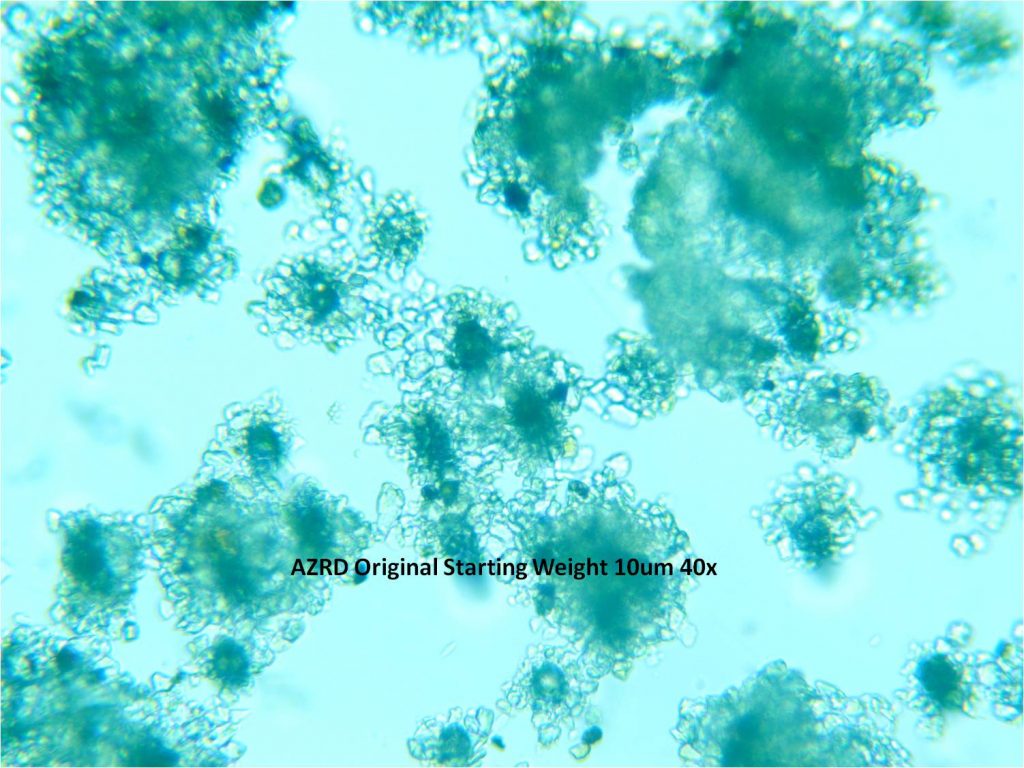
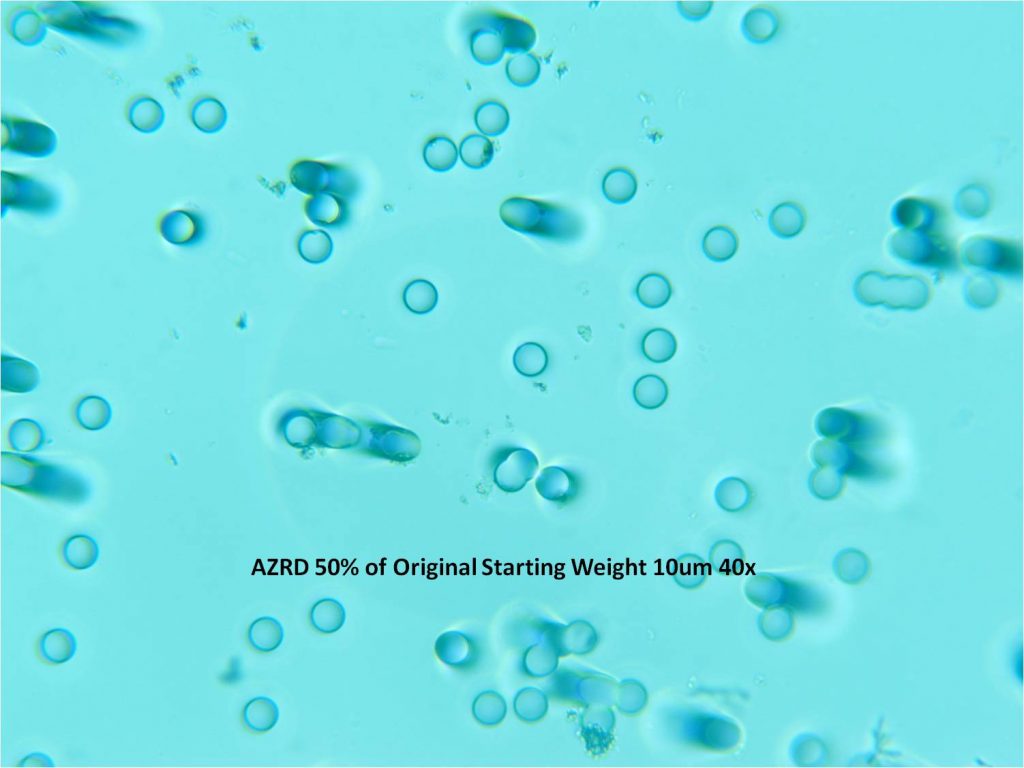
- Once the ideal Starting Weight range is determined, a process called Vacuum Filter Fractionation (VFF) is employed whereby the As-Presented material is placed into a biologically neutral Phosphate Buffered Saline (PBS) solution and sequentially subdivided using 3 fractionation steps. This technique, which utilizes the Starting Weight information discussed previously to determine the appropriate Starting Weight, is highly effective in segregating particulates, with the resulting respirable residues available for an array of high-end characterization techniques.
- Following VFF isolation of the respirable fraction, the amount of Respirable Crystalline Silica (RCS) can be quantified via our leading-edge XRD-Air analysis technique which offers unique sensitivity and an LOD as low as 2.5µg/filter. This method, internationally validated for air sample analysis, is capable of providing the detail needed to achieve GHS (<0.1%) and/or Prop-65 (N/D) clearance. For TiO2 containing materials, we recommend again processing the respirable residues into ICP-OES for quantitation. Like the RCS process, results from this analysis can be used to substantiate GHS (<0.1%) and/or Prop-65 (N/D) clearance. Should clearance be attained at this step in the process, experimental work can be terminated and recommendations made available for SDS Section 3 Hazard Inversion language.
- Should VFF fractionation fail to be a viable approach or XRD-Air and ICP-OES analysis be unsuccessful in achieving Hazard Inversion, we offer Computer Controlled Scanning Electron Microscopy (CCSEM) with IntelliSEM as means of characterizing the <10µm and <5µm VFF fractions. This technique, which utilizes a TESCAN Vega 3 Scanning Electron Microscope loaded with IntelliSEM software, provides highly precise quantitation of free and unbound Si and Ti-Rich particulate within the size fractions of <5µm and <10µm. To generate this information, the IntelliSEM utilizes predetermined Electron Diffraction Scattering parameters and an automated process of analysis to quantify the weight percent of each particle species based on its elemental content (Si, Ti, etc) and aerodynamic diameters (<10μm /<5μm). The technology is a unique part of our GHS-XRC(M) regimen and is directly overseen by a program Subject Matter Expert (SME) who carefully adjusts the analytical parameters as needed to assure robust particle-by-particle quantitation. This same process is used to configure your sample for future inter-instrumental characterization, should additional study be needed.
- Where VFF, XRD-Air, ICP-OES and CCSEM-IntelliSEM fail to achieve clearance, we offer SEM-Raman as another means of providing particulate characterization. This technique utilizes inter-instrumental analysis to conduct quantitation by first, selecting those Si and Ti Rich particles of interest using SEM and second, by analyzing these same particles using Raman spectroscopy. Because Raman, alone, is capable of determining size, mineralogical properties and purity, it is nearly 100% definitive for free and unbound Respirable Crystalline Silica (RCS) and Rutile TiO2 in the fractions <5µm and <10µm. Given the manual nature of this technique, it is also methodical and precise with an SME, specializing in this methodology, again overseeing the process.
As described herein, XRC(M) is a technique by which mineralogical product mixtures containing hazardous components can be accurately evaluated for hazardous agent bioavailability. The methods we employ involve sequential analysis techniques including XRD, Raman, IntelliSEM and ICP as well as other scientific tools to successfully achieve Hazard Inversion. Most importantly, all of these activities are designed to first, evaluate the biological significance of each hazardous component and second, to determine homogeneity, mineralogy and physicochemical makeup of these components in the final product(s). Thereafter, we compare the information generated by this characterization with GHS reporting requirements and assign those exemptions which apply.

Create White Space
Determining Leachable Hazards
Whether the product of interest is mineralogical in character, contains heavy metals or is made up of a complex mixture of organic/inorganic components, the bioavailability of hazardous ingredients remains our focus. To accommodate diverse classification demands, we offer two separate leachability methods, the first of which addresses environmental releases and a second, which is specific to occupational exposures. Both methods are well documented, publicly available and validated by Reddwall Solutions for the purposes intended. Herein is a discussion of these processes and the leachability concerns they address relative to metals. As you’ll note, these same processes are available to investigate a wide range of more complex organic/inorganic agents as well.
- To determine the potential for leachable metals release, as a result of handling or extreme upset, we recommend starting with an assessment of the CA Title 22, CAM-17 metals content. In support of this process, the CAM-17 metals are first quantified in the As-Presented material using ICP-OES. Thereafter, these results are used as a part of our environmental and biological leachability characterization processes to determine which of the those CAM-17 leachable metals found to have a detectable level are in need of evaluation for compliance with UN-GHS and Prop-65 thresholds.
- To facilitate environmental classification, we recommend an abbreviated leaching process for the As-Presented material which employs the Indiana Neutral Leach regimen and serves to extract leachable metals using Deionized Water as the core medium. This approach satisfies classification requirements under UN-GHS and HazCom 2012 SDS Section 12 – Ecological Information and serves to mimic short term spills and releases into the natural environmental as a result of extreme upset by identifying those metals which could leach and enter common waterways or aqueous bodies. Upon completion of this SW-846 process, the leachate is analyzed by ICP-OES for each of the metals shown by previous ICP analysis of the As-Presented material to be in excess of detection limits. These data are then evaluated against existing drinking water standards to determine acceptability and potential for hazard. Simultaneous with this analysis process, the leachate is tested to determine pH compliance with GHS requirements.
- To accommodate determining the potential for GHS-specific occupational exposures, we recommend processing materials through our bioleachability regimen which involves leachable metals extraction using a MOPS-Mucin (Salivary Gland) buffer solution as the medium. This approach, based on jewelry mouthing in children, was developed specifically for our GHS Hazard Inversion process and serves to mimic upper torso body-temperature exposures to salivary openings and exposed skin surfaces over an 8-hr exposure period. Although it is a complex technique, it has been successfully employed for numerous products and is ideally suited to provide a rigorous testing regimen for determining occupational hazard classifications. Upon completion of this biological leaching process, the leachate is analyzed by ICP-OES for each of the metals shown by previous ICP-OES analysis of the As-Presented material to be in excess of detection limits. Thereafter, resulting data are evaluated against derived inhalation/saliva ingestion standards using OSHA, AIHA, and ACGIH occupational exposure limits to determine acceptability and potential for harm.
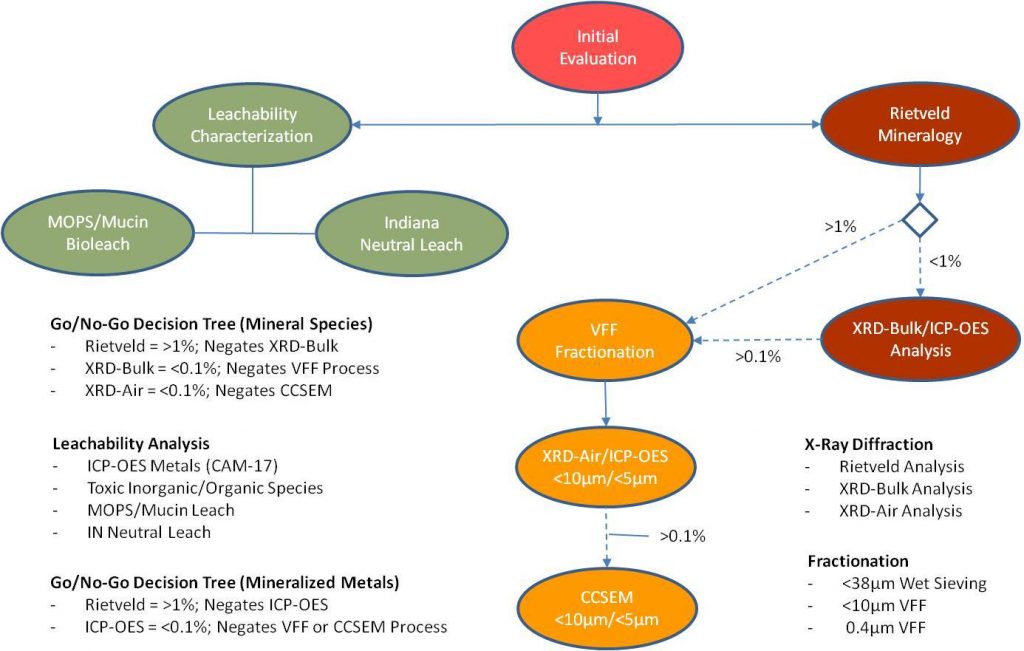
Occasionally, materials present with unique characteristics which necessitates deeper investigation into the underlying particulate profile. To facilitate this occurrence, we process the As-Presented material through our CCSEM methodology in advance of GHS-XRC(M). This serves as a means of strategizing fractionation approaches and as a confirmatory source in potentially exempting the material from GHS and/or Prop-65 classification. Via CCSEM, we obtain both overall particle size distribution and details on the amount of particulate present within each of the toxicologically relevant size fractions (<5µm and <10µm). To more fully describe the complete Hazard Inversion process and the many nuances which exist, herein is a graphic overview, laying out the alternate pathways and some of the go-no-go considerations we employ:
GHS Hazard Inversion
Finally, as a part of the Hazard Inversion process, we offer GHS-Compliant reporting formats and Section 3 Hazard Inversion language for those product(s) successfully achieving reclassification. These services are continuously a part of the process and integral to our GHS-XRC(M) consultation and Hazard Inversion process.
Summary
Should our combination of XRC(M) analysis techniques be unable to achieve the goal of reclassification, we offer additional forms of bioavailability testing including field characterization, release sampling using our self-contained dustiness testing system and real-world applications monitoring. These study tools are designed to specifically determine whether GHS and Prop 65 bioavailability exemptions apply and include protocol development as well as controlled on and off-site release sampling and analysis. While the amount of data necessary to achieve each goal varies, the outcomes are conclusive and provide the documentation needed to claim exemption under both GHS and Prop 65 rules. Finally, should these fundamental tests fail to provide reclassification, our team of professionals offers internationally validated in-vitro tiered toxicology testing and in-vivo biological studies to definitively assess the toxicological potential of each product.
While our established protocols generate the GHS, HazCom 2012, Prop-65, WHIMS, REACH and Dossier supported data needed for product distribution, we also offer Safety Data Sheet authoring services for international distribution in any language, worldwide. Where the Hazard Inversion process is successful and outcomes represent a non-hazardous material, we recommend preparation of our short form SDS. This brief 6-7 page document is issued in Word format and easily revised. Should the product present with significant hazardous classifications or have a foreign country destination, we utilize Chemwatch software to generate fully compliant digitized SDS Documents. This system, which generates a pdf file, is only editable at the preparation source using our internal translation process. Thus, it is more cumbersome to work with, but necessary where complex classification schemes, international distribution or multi-language translations are required. While customers are free to choose digitized SDS Documents up front, the determination as to whether our short form Word version can be utilized generally isn’t known until the GHS-XRC(M) Hazard Inversion process is complete.
Given the complexity of GHS-XRC(M) services, administration includes ongoing consultation and review by our team of Subject Matter Experts. This assures that the correct analytical testing is performed and that critical GHS Hazard Inversion verbiage is appropriate to each product. While some commodity services offer a fixed turnaround time, our progressive analysis approach, sequential laboratory queue times, numerous data reviews, and frequent client communications (updates and approvals) normally result in turnaround times ranging from 4 – 12 weeks. Even though this may appear slow, rigor dictates the pace with numerous inter and intra-laboratory activities occurring each day. Given the attention-to-detail considerations we offer, along with a strategic process flow and litigation-quality data presentation, there is simply no other service as fully suited for product characterization. No matter the scope of work, our consultation continues throughout each project and costs are continuously and completely controlled by the client. As a rough estimate of fees, projects involving limited services normally fall into a price range of $2000-$4000 while those requiring extensive testing and/or complex consultation incur costs ranging from $4000-$8000.
Hopefully, this information has been helpful in describing the underlying detail and importance of our work. In closing, we welcome the opportunity to participate in safely branding your products and look forward to answering any questions you might have.