Blank Line
Materials that confer antimicrobial activity, be that by innate property, leaching of biocides or design features (e.g., non-adhesive materials) continue to gain popularity to combat the increasing and varied threats from microorganisms. To understand how efficacious these materials are at controlling microorganisms, data is usually collected via a standardized test method. However, standardized test methods vary, and often the characteristics and methodological choices can make it difficult to infer that any perceived antimicrobial activity demonstrated in the laboratory can be confidently assumed to an end-use setting.

Blank Line
One of the routine assays, Reddwall Solutions provides is the Agar Well Zone of Inhibition (ZoI) testing. This efficacy screen offers a fast, qualitative means of measuring the ability of antimicrobial agents to inhibit microbiological growth. In the world of antimicrobial substances/surfaces, the degree to which a material can inhibit unwanted growth can be of vital importance to the health of the consumer. The testing described herein represents an outstanding qualitative way for manufacturers of antimicrobial products to be able to compare inhibition levels between and among products.
Blank Line
Like the disk-diffusion method utilized by pharmaceutical manufacturers, an agar plate surface is first inoculated with a microbe by spreading a volume of the microbial inoculum across the entire agar surface. A small circular hole is then punched aseptically into the agar and a precise volume of antimicrobial agent is introduced into the well. Thereafter, the agar plate is incubated under suitable conditions and the antimicrobial agent allowed to diffuse into the agar medium, inhibiting growth of the microbial strain being evaluated.

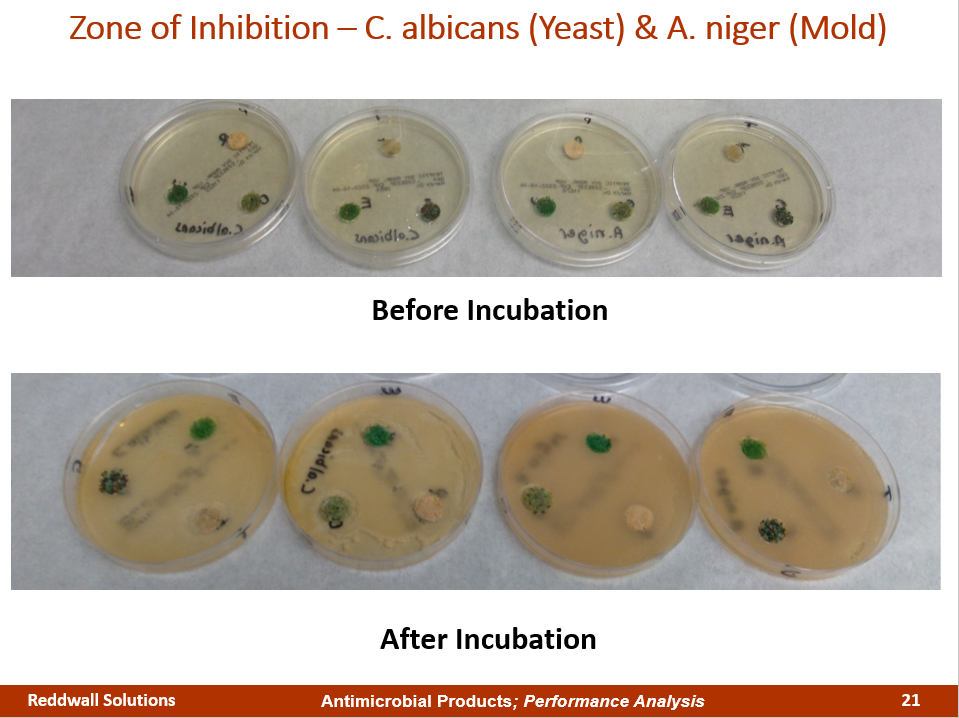
The Well Test Assay, as described herein, is performed utilizing Escherichia coli (Gram-negative), Staphylococcus areus (Gram-positive), Aspergillus niger (fungi), and Candida albicans (yeast) microbe species. The assay itself demonstrates biostatic/biocidal activity by diffusing an antimicrobial agent through water within the nutrient agar. Thereafter, antimicrobial activity is demonstrated via creation of a zone of inhibition wherein microbial growth is inhibited at and around locations containing antimicrobial agents. The dimensions of these zones indicate the relative strength of the agent. This type of testing is based on the Kirby-Bauer disk diffusion susceptibility test for antibiotics and is designed specifically for the purpose of determining the sensitivity of pathogenic bacteria (obtained from medical specimens) relative to an antimicrobial compound.
Blank Line
The second type of assay Reddwall Solutions conducts is called Urease Inhibition Testing. Once again, this routine offers a fast, qualitative means of measuring the ability of microbiological agents to inhibit urease generation. More specifically, the family of enzymes which catalyze the hydrolysis of urea are known as ureases, collectively referred to as “urease”. In the setting of animal areas, the sources of urease are various bacteria. For example, Proteus vulgaris – A rod-shaped, nitrate-reducing, indole-positive and catalase-positive, hydrogen sulfide-producing, Gram-negative bacterium inhabits the intestinal tracts of humans and animals. It can also be found in soil, water, and fecal matter and is an opportunistic pathogen of humans known to cause wound infections along with other species of its genera known to cause urinary tract infections. These bacteria need nitrogen for growth and sustenance. As they cannot utilize urea directly to satisfy this need, they produce urease to convert the urea into the usable form of ammonia.


Blank Line
To evaluate antimicrobial materials for their ability to control ammonia odor generated by Proteus vulgaris, we utilize the Draeger Column procedure. This analysis incubates the sample material inside a Draeger Column for 8 hours at 96.8°F. Thereafter the sample is evaluated for ammonia production. An increase (or lack of) ammonia is measured using the Draeger columns, specifically as ammonia levels rise in the gaseous phase, the pH changes resulting in a color change from yellow to blue in the column. In other words – yellow means ammonia is not present.
Blank Line